Arabic-First Content on Instagram and TikTok: The Data Behind 2–3x Higher Engagement in UAE
Why Arabic-first content drives 2-3x higher engagement in UAE. Explore the data, platform trends, and a language audit framework for Instagram and TikTok.
Every international brand entering the UAE assumes English is enough. The data says otherwise.
With 11.3 million social media user identities against a population of 11.2 million, the UAE has effectively achieved 100 percent social media adoption. This is not a market where reach is the problem. Visibility is table stakes. The real competitive variable is engagement, and on Instagram and TikTok, Arabic-first creators consistently report substantially higher engagement than their English-first counterparts, a differential practitioners across the region estimate at two to three times, though results vary by vertical and creative quality. Yet most international brands continue producing content in English by default, leaving that advantage entirely on the table.
This analysis breaks down why that gap exists, what it actually costs brands to ignore it, and how to act on it systematically. You will find the platform-level evidence behind the engagement differential, a practical language audit framework, and a clear comparison of Arabic-first, bilingual, and English-first content models. Whether you are refining your social media content creation strategy or building one from scratch, the goal here is to give you a data-grounded basis for making language decisions that compound over time rather than ones that simply feel familiar.
Why the UAE Is the World's Most Saturated Social Media Market

According to DataReportal's Digital 2025 report, the UAE recorded 11.3 million social media user identities in January 2025, equating to 100 percent of the total population. By October 2025, that figure had climbed to 12.5 million, or 110 percent, reflecting widespread multiple-account ownership. No comparably sized market matches this level of saturation.
Internet penetration reinforces the picture: 99.0 percent of residents are online, meaning reach is effectively a solved problem for any brand with a UAE presence. When distribution is universal, the competitive lever shifts entirely to what you publish and in what language.
The audience is also geographically concentrated. 88.1 percent of the 11.2 million population lives in urban centres such as Dubai, Abu Dhabi, and Sharjah. These are high-bandwidth, always-connected environments where short-form video and platform-native formats perform at their ceiling. Density amplifies engagement velocity in ways that dispersed markets simply cannot replicate.
Demographically, the population skews 63.8 percent male and is expanding at 3.5 percent annually, adding roughly 376,000 residents each year. These characteristics matter when building a social media content strategy calibrated for this market rather than imported from a global playbook.
The strategic implication is direct: full digital saturation eliminates reach as a differentiator. Every brand has a presence. Every post reaches an online audience. What separates performance from noise is content quality and, critically, language and cultural resonance. Understanding why marketing in Dubai demands a different approach starts here, with this data.
Instagram and TikTok as the Dominant Battlegrounds in MENA
Within that saturated digital landscape, two platforms dominate where attention actually converts: Instagram and TikTok. Across MENA, both consistently rank as the primary engagement channels, and UAE users sit at the high end of per-capita interaction rates globally.
What makes these platforms strategically distinct is their algorithmic architecture. TikTok distributes content based on signal quality, not audience size. A brand account with 500 followers producing strong Arabic-first social media content can outperform an established English-language account on a single video if early retention and engagement signals are strong. Follower count is not a moat here.
Instagram Reels operates differently but arrives at a similar outcome. Its discovery layer weights saves and shares more heavily than passive views. Culturally resonant, language-matched content consistently drives those higher-intent behaviours more than translated or English-default posts, because the audience recognises the content as made for them rather than adapted at them.
Both platforms also distribute to interest graphs, not just social graphs. A user who has never encountered a brand can receive its content purely because their behaviour signals topical relevance. Arabic-language social media content creation can therefore penetrate cold audiences organically, without a paid amplification budget behind it.
That structural dynamic is what makes language choice, explored next, the primary organic lever remaining.
What the 2–3x Engagement Differential Actually Means and Where It Comes From
The 2–3x engagement figure often cited by Arabic-first practitioners in the UAE is a directional industry estimate, not a figure from a single peer-reviewed study, and that distinction is important context for how to use it. Brands should use it as a calibrated hypothesis to test against their own data, not a guaranteed return to invoice against a content budget.
The structural conditions producing this gap are, however, well-documented. Culturally matched language measurably reduces cognitive friction, the mental processing cost a reader absorbs when content does not match their primary identity language. Lower friction correlates directly with higher comment likelihood and stronger save and share behaviour, the precise signals that Instagram Reels and TikTok's distribution algorithm weight most heavily when deciding how broadly to push a post.
Across MENA creator accounts, the pattern is consistent: profiles publishing in Arabic or Arabic-primary bilingual formats outperform reach-adjusted equivalents in English. Practitioners most commonly report the differential in categories where purchase decisions are emotionally loaded and culturally specific, such as food, fashion, lifestyle, and personal finance. These verticals share a common thread: purchase and aspiration decisions that are emotionally loaded and culturally specific.
That cultural dimension is where the data becomes most instructive. The engagement gap is not purely about language comprehension. Arabic-first social media content sends a signal that a brand is speaking to an audience rather than translating at them. That distinction registers emotionally, and emotion is what drives shares.
Treat it as a hypothesis your own analytics will either confirm or qualify, the audit framework in Section 5 gives you the method. The actual differential a brand achieves depends on vertical fit, creative quality, and whether the Arabic is produced natively or processed through a machine-translation tool, a difference UAE audiences recognise immediately.
Why Most International Brands Still Default to English and What It Costs Them
Knowing the engagement gap exists is not enough if structural inertia keeps a brand producing English content by default. That inertia is primarily organisational. Global content teams build their approval chains, asset libraries, and social media content creation workflows in English because that is the language headquarters operates in. Retrofitting those systems for Arabic requires right-to-left design templates, native Arabic copywriters in the review chain, and revised sign-off processes. Most teams acknowledge this and then delay it indefinitely.
The most common rationalisation is demographic: with the UAE's large and diverse expat majority, the logic goes that English is the shared operating language and therefore sufficient. That reasoning mistakes workforce composition for platform behaviour, because cultural resonance and language match drive interaction depth beyond raw headcount.
The cost of that rationalisation accumulates silently at the algorithm level. Both platforms read engagement signals to calibrate future distribution. Posts that underperform with Arabic-dominant segments accumulate weaker engagement signals over time, and on platforms that weight signal quality heavily, that pattern shapes future distribution in ways a single weekly report rarely makes visible.
This is precisely why paid amplification cannot fully compensate. Organic engagement depth, built through culturally matched content, creates audience signals that money cannot simply override. Local and regional Arabic-first creators have been accumulating those signals for years, and brands that understand why GCC-first thinking defines effective regional strategy recognise the structural advantage this creates.
Once that engagement depth is established, the algorithmic gap compounds each quarter, making recapture progressively more expensive for brands that move late.
The Language Audit: A Framework for Deciding Your Arabic-English Content Mix
Closing that gap starts with your own data, not industry benchmarks.
Step 1: Audience language mapping. Open Instagram Insights and TikTok Analytics, filter by UAE location, and review which audience segments are actually engaging. Then manually review a sample of recent comments and DMs and split them by language. This establishes your organic language baseline before any production decision is made.
Step 2: Content performance baseline. Go back 90 days and tag every post as Arabic-first, English-first, or bilingual. Calculate median engagement rates for each group. This single analysis routinely surfaces a gap brands have been sitting on inside their own accounts without realising it.
Step 3: Vertical and category scoring. The Arabic-first uplift is not uniform across content types. Entertainment, humour, and personal finance content in Arabic tends to show the sharpest differential, based on practitioner patterns rather than published benchmarks. B2B and technology content aimed at a predominantly expat buyer profile often performs better with a bilingual approach. Score your content categories before committing production resources.
Step 4: Production capacity assessment. Arabic-first social media content creation requires native Arabic copywriters with Gulf-register fluency; machine translation and bilingual staff with English-dominant workflows are not substitutes. Assess honestly whether this capability exists internally or needs to be sourced through a content creation agency with verified Arabic creative credentials. Capability gaps at this stage are the most common reason well-intentioned language strategies stall.
Step 5: Testing protocol. Select your three highest-performing English posts and produce Arabic-first variants. Run them organically for 30 days. For a deeper look at how format interacts with language strategy on Instagram and TikTok, keep reading here. The data you collect in that window is brand-specific and worth more than any generalised benchmark.
Arabic-First vs. Bilingual vs. English-First: Choosing the Right Model for Your Brand
Once your audit delivers a language split and a performance baseline, the next decision is structural: which model fits your brand's specific audience composition?
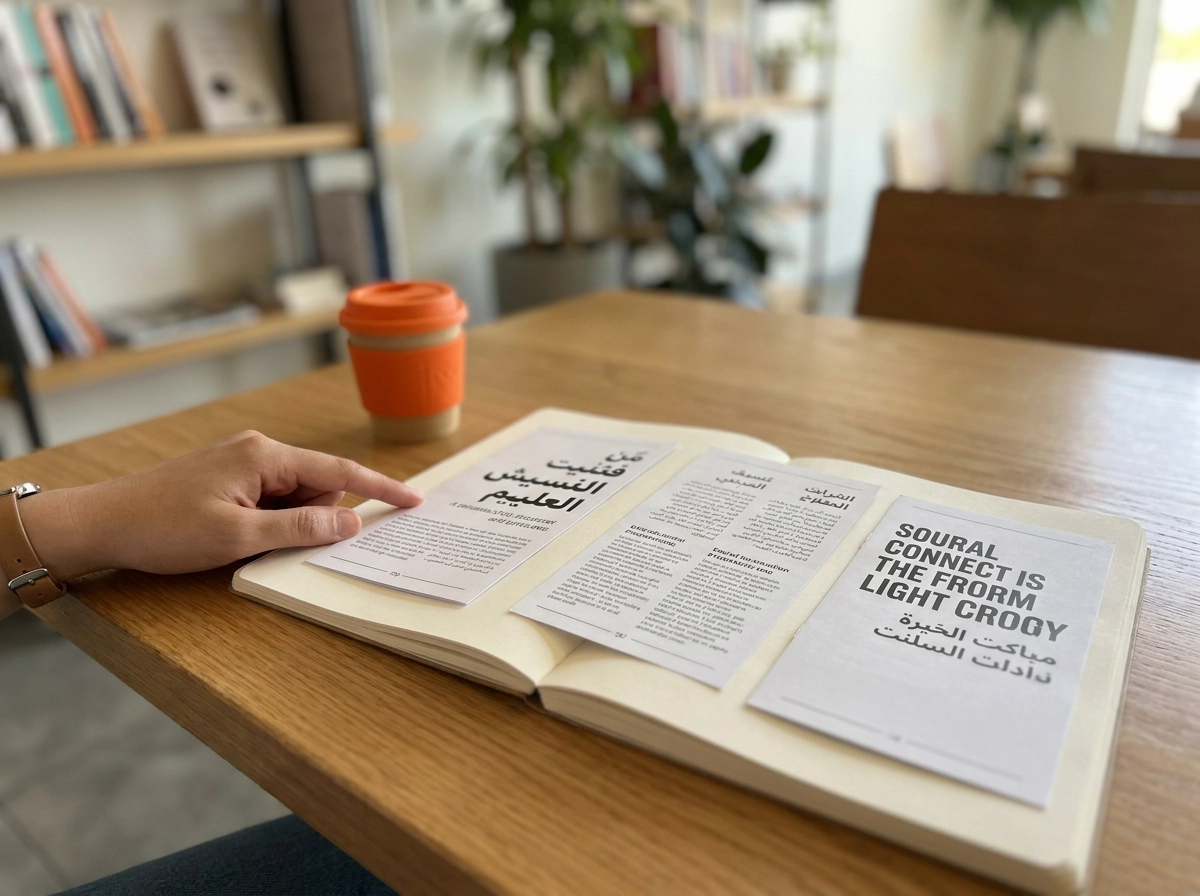
Arabic-first (Arabic headline and primary caption, with an optional English subtitle) is the strongest model for brands targeting Emirati nationals, Arabic-speaking Arab expats, and Gulf-region audiences broadly. Arabic is not merely a communication preference for these audiences; it is a primary identity language, and content that leads in Arabic signals cultural respect rather than accommodation.
Bilingual content, where Arabic and English appear simultaneously in a single post, suits brands serving a genuinely dual audience of local Arabic speakers and English-dominant expats. The critical risk: if the Arabic component reads as a translation appended to an English-original caption, it functions as neither and satisfies neither. For bilingual to work, both languages must carry co-primary weight in the creative brief, not the production queue.
English-first remains defensible where your UAE audience is concentrated in professional expat sectors such as technology, finance, or consulting. Even here, adding Arabic to Stories and responding to comments in Arabic delivers measurable engagement increments without requiring a full content overhaul.
For most international brands, a tiered model is the most practical social media content strategy: Arabic-first for Reels and high-reach formats where algorithmic amplification determines outcome; bilingual for product and service posts where conversion clarity is the priority; English for B2B and recruitment content with expat-dominant readership.
A quarterly review against your Insights data keeps the model calibrated as UAE audience composition and platform behaviour evolve.
Social Media Content Creation in Arabic: What Quality Actually Requires
Choosing the right language model is only half the equation. Executing it to a standard UAE audiences will actually reward requires production decisions that most brands underestimate.
Gulf Arabic is not interchangeable with other Arabic dialects. Levantine and Egyptian registers are immediately recognisable to UAE audiences, and content written in the wrong dialect signals inauthenticity as sharply as a spelling error would in English. Native Gulf Arabic copywriters are a non-negotiable requirement, not an upgrade.
Right-to-left rendering is a technical discipline, not a checkbox. Instagram carousel cards, TikTok captions, Story overlays, and Reel subtitles each handle Arabic typography differently. Broken ligatures, reversed punctuation, and misaligned text are among the most common reasons Arabic-first content underperforms despite well-written copy. Every format requires device-level testing before publication.
Design adaptation cannot be skipped. Arabic and Latin scripts differ in reading direction, typographic weight conventions, and visual hierarchy. Dropping Arabic copy into an English template produces layouts that feel structurally wrong to native readers. Genuine localisation requires a design review, not a text swap.
Arabic voiceover is the highest-leverage production investment available. Audiences are far more likely to watch through video content delivered in their native language than to read subtitles on content produced in another, making native Arabic voiceover one of the highest-leverage production upgrades available.
Agencies such as Round Social, with embedded Arabic creative teams based in Dubai, consolidate copy, design adaptation, and platform rendering into a single workflow. That integration removes the coordination overhead that causes in-house Arabic content initiatives to stall before they produce results.
The Compounding Advantage of Moving First

Getting the production standard right, as covered above, is the prerequisite. Acting on it quickly is the advantage.
The engagement differential for Arabic-first content in UAE is not an emerging trend to monitor at a comfortable distance. It is an algorithmic and cultural reality already rewarding brands that have made the shift, and compounding against those that have not. A competitor builds deeper signal with the same audience every month a brand delays.
Prioritise Arabic-first production for Reels and TikTok videos before any other format. These carry the highest algorithmic amplification potential in UAE's fully saturated social environment. A single well-executed Arabic-first Reel delivers reach and engagement depth that no English-language equivalent in the same feed can match on a per-dirham basis.
Treat Arabic content quality as a brand standard, not a cost line. Native copy and Gulf-dialect accuracy are the minimum threshold for the engagement gains the data points toward. Machine translation does not meet that threshold. Approving substandard Arabic copy to save budget is the fastest way to produce content that performs worse than English defaults.
The audit steps outlined in Section 5 take under an hour and surface a gap most brands have been sitting on. Brands that complete it today build algorithmic depth with UAE audiences that late movers will find genuinely expensive to close.
Conclusion
The brands already acting on the Arabic-first advantage are building algorithmic depth that grows harder to compete with every month.
Four truths define the opportunity. The UAE audience actively rewards cultural and linguistic authenticity. Instagram and TikTok amplify that signal algorithmically, multiplying reach beyond the initial post. Quality Arabic content requires genuine native expertise, not shortcuts. And first movers compound their advantage while competitors are still deliberating.
The data exists in your own analytics right now. The brands that act on it this week will be the ones your competitors are studying next year.